When it comes to managing time and tasks, we often find ourselves overwhelmed by an ever-growing to-do list. The key to staying productive and reducing stress lies in prioritizing tasks effectively. One of the most powerful tools to help you do this is the Eisenhower Matrix. This simple yet effective method can guide you in identifying what truly needs your attention and what can be delegated or postponed.
In this article, we’ll explore how you can use the Eisenhower Matrix to categorize your tasks into four quadrants and take control of your time management.

What Is the Eisenhower Matrix?
The Eisenhower Matrix, also known as the Urgent-Important Matrix, is a time management tool that helps you prioritize tasks based on their urgency and importance. This method was popularized by Dwight D. Eisenhower, the 34th President of the United States, who was known for his ability to make swift and effective decisions. The idea behind the matrix is simple: categorize your tasks into four distinct groups, which will allow you to focus on the most important and time-sensitive tasks first.
The Four Quadrants of the Eisenhower Matrix
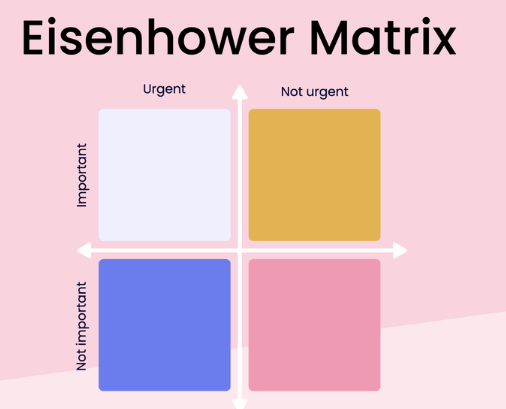
The Eisenhower Matrix divides tasks into four categories based on two criteria: urgency (how soon a task needs to be done) and importance (the value or impact of the task). The matrix is divided as follows:
- Quadrant 1: Urgent and Important (Do First)
- Quadrant 2: Non-Urgent but Important (Schedule)
- Quadrant 3: Urgent but Non-Important (Delegate)
- Quadrant 4: Non-Urgent and Non-Important (Eliminate)
Let’s break down each quadrant and how you should approach tasks in each category.
Quadrant 1: Urgent and Important (Do First)
These are the tasks that require immediate attention and have a significant impact on your long-term goals or well-being. They are both urgent (they need to be done soon) and important (they contribute directly to your responsibilities, personal life, or business).
Examples:
- A project deadline that is fast approaching.
- A medical emergency or urgent personal matter.
- A client issue that needs to be resolved immediately.
Action:
Focus on completing tasks in this quadrant first. These tasks cannot be delayed because they have immediate consequences. Prioritize them to avoid unnecessary stress or negative outcomes. It’s essential to stay on top of these tasks to maintain productivity and meet critical deadlines.
Quadrant 2: Non-Urgent but Important (Schedule)
Tasks in this category are important for your long-term success but are not time-sensitive. These are often things that contribute to your personal development, business growth, or overall well-being. Although they don’t need to be done immediately, neglecting them could hurt you in the future.
Examples:
- Setting long-term career goals.
- Exercising or maintaining health.
- Building relationships and networking.
- Working on a strategy for personal or professional growth.
Action:
Schedule these tasks into your calendar. These are the tasks that often get pushed aside because they aren’t urgent, but they are vital for long-term success. By dedicating time to these tasks regularly, you can prevent them from becoming urgent in the future.
Quadrant 3: Urgent but Non-Important (Delegate)
These are tasks that require immediate attention but don’t significantly contribute to your long-term goals or well-being. They can often be distractions that take up your time without providing meaningful value.
Examples:
- Attending meetings that don’t require your full participation.
- Responding to emails that are not directly related to your goals.
- Handling minor issues that could be resolved by someone else.
Action:
Delegate these tasks if possible. If you are unable to delegate, try to minimize the time spent on them. Outsourcing or giving responsibility to others will free up your time for tasks in Quadrants 1 and 2 that have a more significant impact.
Quadrant 4: Non-Urgent and Non-Important (Eliminate)
These are tasks that are neither urgent nor important. They don’t contribute to your goals or well-being and are simply time-wasters. They often serve as distractions that can derail your productivity.
Examples:
- Mindlessly scrolling through social media.
- Watching TV shows or movies that don’t bring you joy or relaxation.
- Engaging in gossip or unrelated chit-chat.
Action:
Eliminate these tasks or minimize them as much as possible. Spending time on Quadrant 4 activities can lead to a lack of focus and wasted time. Try to avoid them during work hours or when focusing on more important tasks.
How to Use the Eisenhower Matrix Effectively
Now that you understand the four quadrants, here are some tips for using the Eisenhower Matrix to optimize your time:
- Start with a Brain Dump:
Write down all of the tasks you need to do. This will give you a clear picture of everything on your plate and allow you to begin sorting them into the four quadrants. - Categorize Each Task:
Ask yourself:
- Is this task urgent and important?
- Is it important but not urgent?
- Is it urgent but not important?
- Is it neither urgent nor important?
- Focus on What Matters:
Prioritize Quadrant 1 and 2 tasks, but don’t forget to make time for Quadrant 2 tasks. These are often the tasks that lead to long-term success. - Delegate or Eliminate:
For Quadrant 3 tasks, delegate as much as possible. For Quadrant 4 tasks, eliminate them from your routine or limit the time spent on them. - Review Regularly:
Life changes, and so do your priorities. Regularly review your tasks and adjust the categorization as needed to stay on track.
Conclusion
The Eisenhower Matrix is a powerful tool to help you prioritize tasks and stay productive. By focusing on what’s truly important and urgent, delegating the non-important tasks, and eliminating time-wasters, you’ll have a clearer path toward achieving your goals. Remember, the key is not just to tackle more tasks, but to tackle the right tasks. Prioritize effectively, and you’ll make more progress with less stress.
By consistently applying the Eisenhower Matrix to your daily life, you’ll find yourself being more efficient, focused, and ready to take on whatever comes your way.
 Make Me Better Thrive
Leave a comment